
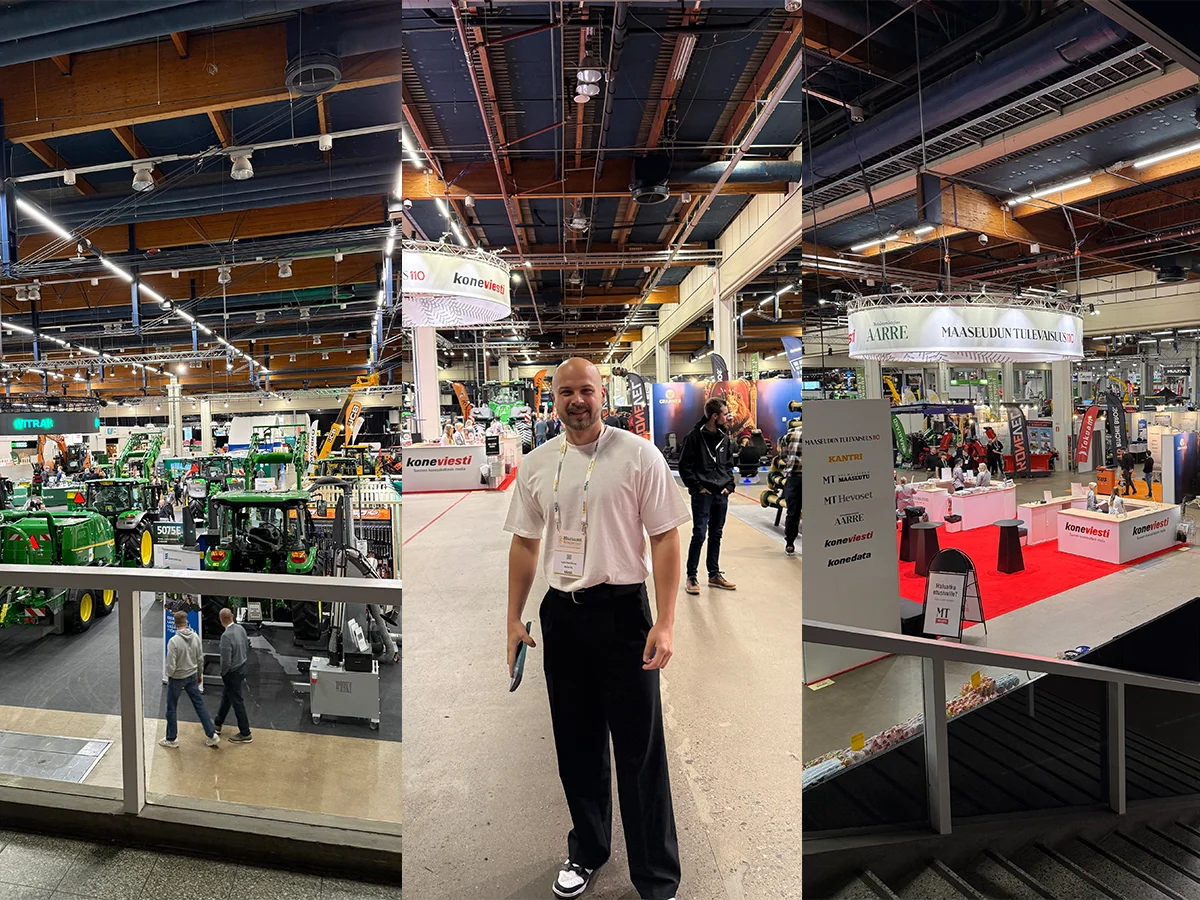
Big machines, down-to-earth buzz and one question that came back to the discussion time and time again! The Helsinki Exhibition and Convention Centre was filled with machines, and the Mobie / CompetenceX crew was in the middle of the hustle and bustle. A lot of experiences were gained from the Agricultural Machinery Fair 2026, and here are the most important takeaways!
Our Santtu and Tapio toured a large part of the hall already on the first day of the fair. They directed the discussions to commissioning and product training and asked how the training is handled now and whether it could be done differently.
Experiences of the Agricultural Machinery Fair 2026: tire kickers stayed at home
“You could clearly see that the people were very targeted. There weren’t too many tire kickers who came just to watch,” says Tapio. He thinks that the entrance ticket contributed to the crowd screening, and the hall was buzzing and down-to-earth. Tapio was most surprised by the size of the machines.
Santtu noticed that there was a decision-making person in each stand. “There weren’t just salespeople, but there was a selection manager and a product manager. However, these are the big gentlemen who were there.”
Robotics is part of everyday life
Santtu also noticed how digitalised agriculture is: robotics is part of everyday life, and it is increasing all the time. Robots are not a new phenomenon, but there are more and more of them all the time, and they are developing rapidly. According to him, the machines also looked different from previous years.
According to Santtu, even after training, users always return to the same question: how was this supposed to be done? The bigger and smarter the machine, the more the user has to learn. Who will teach it to them?
Deployment is still done over the phone and live
The recurring message was clear: implementation training is largely carried out live and over the phone, and training the customer is often the responsibility of the salesperson. Most of the people we met at the departments believed that they could be handled more efficiently, but training done online or with the help of artificial intelligence was not yet on many people’s minds. What has worked in the past is still working now. Some large players already have their own applications, such as a checklist for customer implementation training.
According to Santtu, the biggest hurdle is how to convince the customer that the training can also be completed online. Young people are often “digital fluents”, while older people are used to the phone and face-to-face service. According to Tapio, the new method does not replace the old one, but supports it: it makes customer service more efficient, facilitates after-sales and reduces the number of contacts in the early stages.
Experiences of the Agricultural Machinery Fair 2026: what did you get out of it?
The Agricultural Machinery Fair 2026 confirmed that the need for product training is not theoretical. Machines are growing and there are more intelligent machines, but the implementation is still largely done by traditional means, and there is room for a new way that supports the old. Flyers were also handed out talentedly, on the benches of the competence panel and on the tables in the canteen!
Next, the focus will turn to the Energy Fair in Tampere, which will start on Tuesday 20 October. There, we will talk about electrification, energy storage, hydrogen and system security, and expertise has a say in everything. Stay tuned, or book a 30-minute sparring session now!