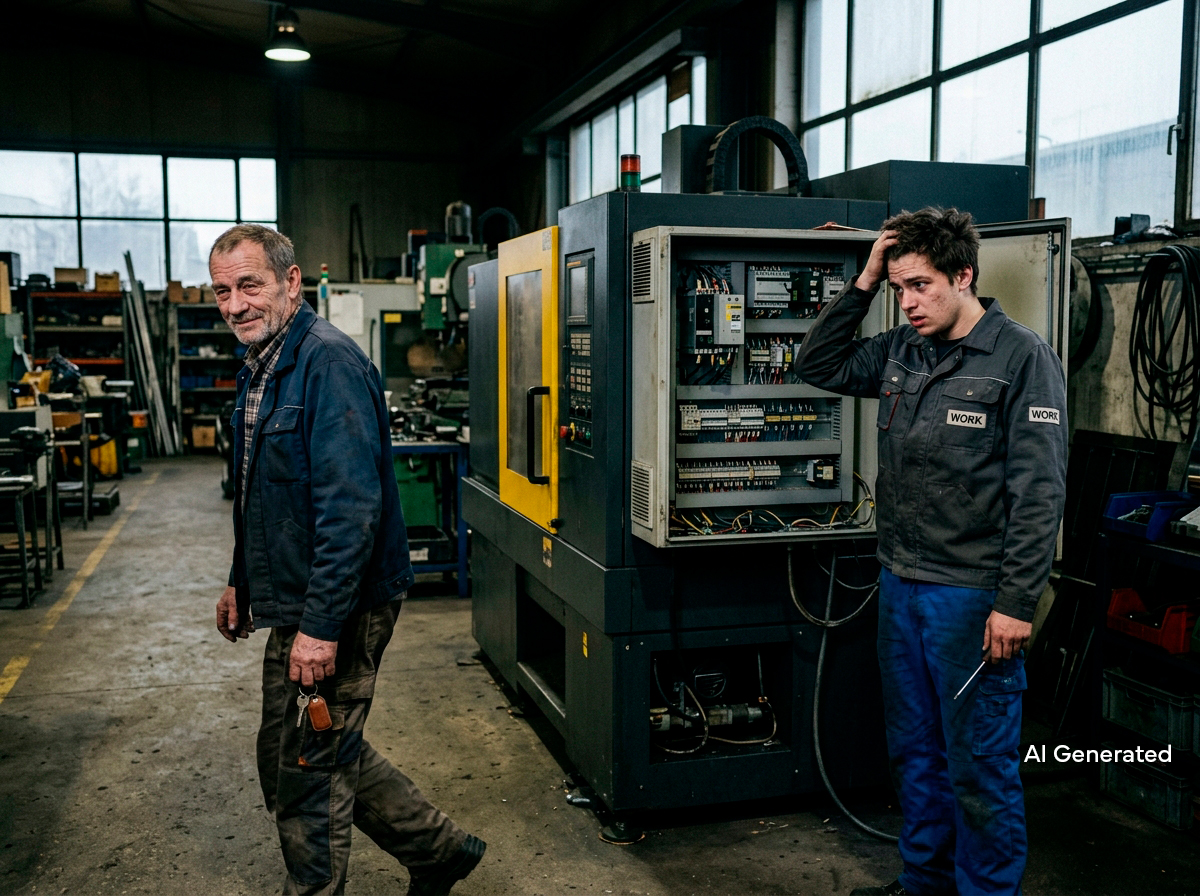
The service technician will change sooner or later, either due to a change of job, retirement or a change in job description. An experienced service technician knows the machine better than anyone else in the house.
He recognizes the fault sound on the phone before he arrives. He knows which spare part should be ordered in advance, and in what age machines, which component starts to fail. This information is not in any manual. It’s in his head.
When this technician changes jobs, retires, or moves on to other positions, all this information leaves the house on the same day as him.
When a service technician changes, tacit knowledge does not transfer by itself
Companies know how to prepare for many things: the availability of spare parts, equipment maintenance intervals, budgets. Preparations are rarely made for the transfer of the expertise of an individual key person before it is too late.
A typical situation proceeds like this: the notice period is a few weeks or months, during which the new technician is tried to be “introduced” by accompanying the old technician to service visits. This is better than nothing, but it is also a very imperfect way to pass on years of know-how:
- Only the part of the know-how that happens to come up during the service visits in which the new technician is involved will be transferred
- Rare but expensive fault situations may not coincide with the induction period at all
- The new technician doesn’t know what to ask because he doesn’t yet know what he doesn’t know
What does this cost in practice
When the skills of an experienced technician have not been properly transferred, the consequences are visible for a long time after his departure:
- Slower troubleshooting when a new technician has to sort out things that their predecessor would have identified in the blink of an eye
- Unnecessary spare parts orders and return visits when the first diagnosis is wrong
- The customer notices the difference in the quality of service, even though the company and the contract remain the same
This is exactly the same cost of the skills gap that can be seen more widely: when the user’s or servicer’s skills are not at a sufficient level, downtime and repair costs increase, even if the device itself is in perfect condition.
When a service technician changes, the solution is not to hope that no one will ever change jobs
Staff turnover cannot be prevented, and it is not worth trying to solve it with the mere hope that key people will stay with the company forever. The solution is to ensure that competence is not tied to just one person.
CompetenceX makes this possible:
- The competence of an experienced technician is recorded as structured training well in advance, not only in the last weeks of the notice period
- Information remains the company’s property, it does not leave with the door when a person changes jobs
- The new technician can access exactly the information they need, directly at the machine behind the QR code, not just what happened to come up during the onboarding period of a few weeks
- The development of competence is visible in real time, which shows where the new technician still needs support
An experienced technician is irreplaceable as a person. Her skills should not be invaluable.
If you recognize this risk in your own organization, you should familiarize yourself with how product training works in practice, or read why the level of induction is decisive in a machine trade.
Is there a key competence in your organization that is in danger of disappearing with one person? Let’s meet at the FinnMETKO 2026 fair in Jämsä on 3-5 September, or book a 30-minute sparring session and see together how to recover that expertise in time.
Frequently Asked Questions
What happens when an experienced service technician changes jobs?
Years of tacit knowledge of the machine’s fault history and maintenance needs leaves the company on the same day, if it has not been recorded as structured training in advance.
Why is a traditional induction period not enough to transfer competence?
Only the part of the expertise that happens to emerge during the service visits in which the new technician is involved is transferred. Rare but expensive fault situations may not be dealt with at all.
How can the expertise of a service technician be retained in the company?
The skills of an experienced technician should be recorded as structured training well in advance, not only in the last weeks of the notice period, when the information remains the company’s property.