
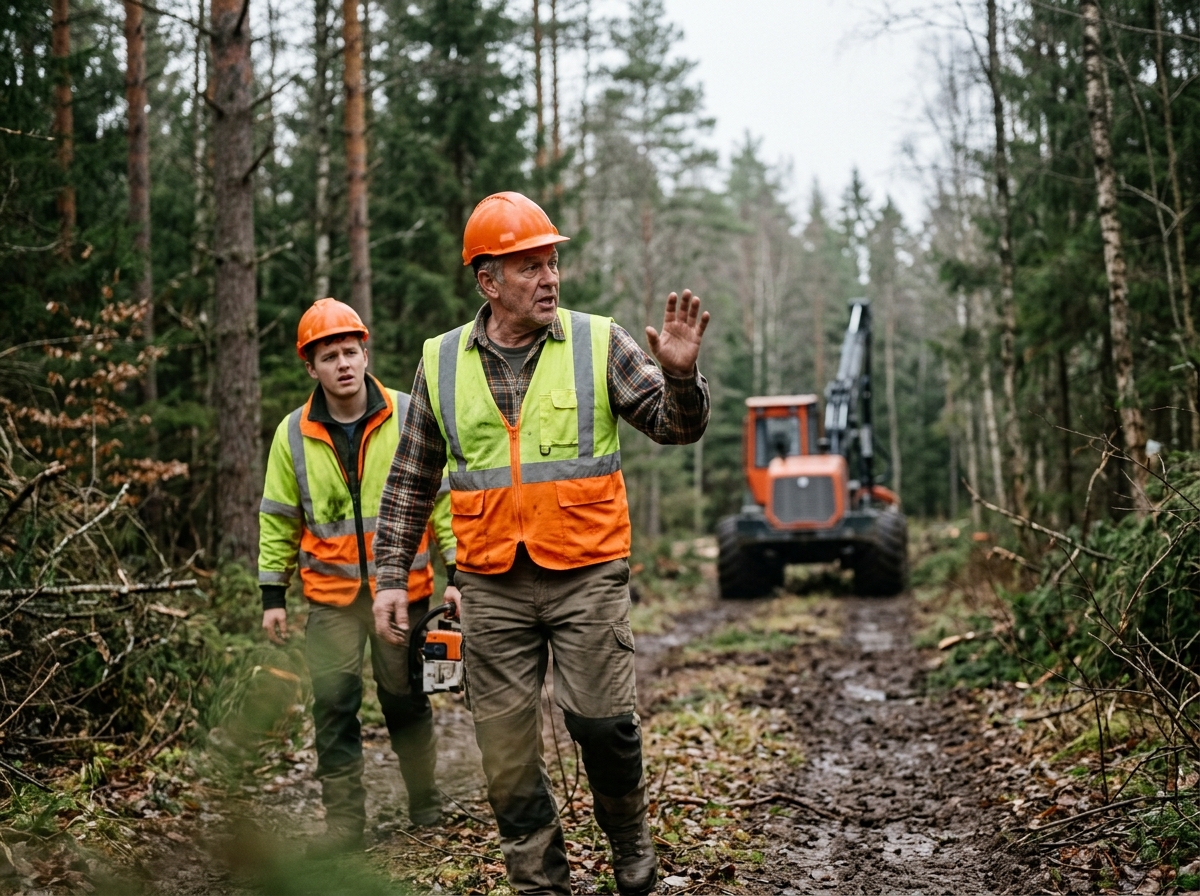
Induction takes too much time in many companies in the machinery industry, but the real problem is not only the use of time, but the level of induction. When the training material created in a hurry remains at a level that barely meets the formal requirements, customers learn to use the machine more slowly than they should, and maintenance calls accumulate for things that could have been avoided with proper induction.
Here are three signs that indicate that the time spent on onboarding and its level do not match, and what should be done about it.
1. The level of orientation is a matter of chance if the training material is not created until the night before
If the delimbing head adjustments, the principles of path planning or the forwarder’s loading logic of a new harvester model are reviewed with a last-minute PowerPoint slide show, it is a clear sign of a problem.
Training is not part of a planned process, but a one-time heroic act.
A slideshow is not an education. It is a material that is easily left without going through properly and quickly becomes obsolete with the next cab update. The quality varies depending on who happened to assemble it and how much time they had available.
2. The company knows what should be trained, but no one has the time
This is the most common sign, and it’s especially frustrating because the talent already exists in the company. Product experts know exactly how to properly adjust the blades of the delimbing head and how to design the tread according to the terrain. They also know which operating errors most often lead to breakdowns in the forest.
The problem is not a lack of expertise, but the fact that no one has the time to translate it into a functional training for the dealer and service network. This leads to the fact that the training is not done at all, it always falls to the same person who is already overworked, or the end result is a user manual that barely meets the minimum legal requirements, not the level that would actually prevent problems in use. None of these results raise the level of onboarding to the level that the business really needs.
3. The level of induction suffers when the training lacks a common thread
Without a clear framework, the training situation easily turns into a free-form conversation that takes place in the forest between transitions or on the phone in the middle of the working day. Important issues, such as choosing the felling direction in difficult terrain or the weight distribution of the loading, are left uncovered. The learner does not know where to pay attention, and the end result depends more on the trainer’s day than on the planned content.
This is particularly evident in the sales and service network: when induction is inconsistent, the skills gap is transferred directly to the forest machine entrepreneur and eats away at both productivity and customer satisfaction. In the field, machines are constantly compared with each other, and the user’s expertise is directly reflected in how the machine fares in this comparison.
The driver decides more than the machine
The technology difference between machines is often smaller than people think: the majority of manufacturers are able to offer sufficiently capable solutions for the same job. What really distinguishes machines from each other in the forest is the user’s expertise. Ideally, the machine would be so easy to use that no user manual would be needed at all, but since this is not realistic, the solution is how well the users can be trained in the use of the machine and daily maintenance.
The starting level of users varies considerably depending on the market, and this is the biggest blind spot in training. For an experienced user with training in the field, it is enough to go through the special features of the machine and maintenance objects, there is no need to teach the working method itself. In emerging markets, the starting point can be completely different: it is not just about the use of the machine, but about the basics such as the concept of a workstation, efficient work order and daily maintenance that the user has no idea about beforehand. Expecting one and the same training to serve all these groups is unrealistic, and it is often precisely for this reason that the training is not done or half-finished.
What does the skills gap cost in practice?
The level of onboarding is not just an internal quality issue, as these three brands come with a concrete price tag. An incorrectly used delimber, a poorly designed track or incorrect loading are not just a momentary inconvenience. This is directly reflected in breakages, terrain damage and downtime in the middle of the logging month.
According to research in the field, a significant proportion of unplanned shutdowns in large companies are caused by a lack of expertise and operating errors, not by the equipment itself. When the induction is not in order, it is not only reflected in the training department’s calendar, but directly in the machine’s utilization rate and the forest machine entrepreneur’s result. In the largest purchases, where pre-purchase tests and productivity monitoring during use are commonplace, a lack of expertise can determine which manufacturer’s machine to choose next.
If the onboarding takes too much time, the solution is a process and technology instead of a manual work
Induction takes too much time when it is always built from scratch manually and without a clear framework. The solution is not for experts to try to scratch more hours off their calendars. The solution is to make education a part of the business and build it into a permanent part of the organization’s expertise.
CompetenceX provides product training with the help of an AI-assisted learning environment and adapts to the starting level of different user groups: the same content can be used to build both a short, hands-on basic training and a more in-depth module for more experienced users. Tacit knowledge in the minds of experienced operators and installers, such as identifying machine maintenance intervals, resolving exceptional situations or planning an efficient work schedule, is a company’s most valuable asset. When this information is transferred into structured, repeatable training, it does not remain dependent on who happens to be present for the induction. In this way, competence develops evenly throughout the organization and the common thread remains regardless of the market or skill level in which the user starts. Experience becomes permanent, shareable competence instead of disappearing with individual employees.
If you recognize these signs in your own organization, you should familiarize yourself with how product training with the help of artificial intelligence works in practice, or read customer experiences about product training. For example, adjusting the delimbing heads of the harvester head has a direct impact on the delimbing quality and durability of the head. This reminds us why technical know-how should be transferred to structured training and not left to chance, no matter how experienced the user is.
Do you recognize one or more of these signs in your company? Let’s meet at the FinnMETKO 2026 fair in Jämsä on 3-5 September, or book a 30-minute sparring session and let’s see together where your orientation process should be lightened.
Frequently Asked Questions
Why is the level of induction decisive in a machine trade?
The technology difference between machines is often smaller than people think. What really distinguishes the machines from each other in use is the user’s expertise.
What are the signs that the level of induction is inadequate?
Three common signs are: the training material is not created until the night before, the house knows what should be trained but no one has the time, and the training lacks a clear common thread.
How can the level of induction be kept high at different skill levels?
The same content can be structured in such a way that it creates both a short, practical basic training and a more in-depth module for more experienced users.