
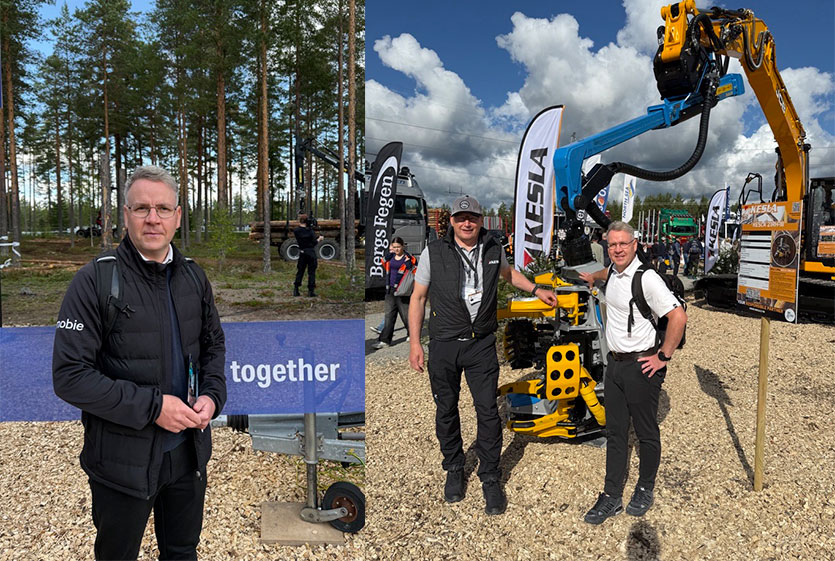
The machine work industry is often perceived as a traditional field where things are learned with experience and the guidance of an older colleague, not so much from the screen of a display device. When we were collecting experiences from FinnMETKO 2026 in Jämsä, we noticed that it is not the whole truth.
“I have to say that it was a positive surprise,” says Tapio Hämäläinen, who went to Jämsä together with Santtu Viljakainen to see what the machine work industry really thinks about product training. Already on the first day, it was noticeable that something was changing: machines are becoming more complex, large operators are digitizing at a rapid pace, and there is a genuine demand for training.
FinnMETKO 2026 experiences: in the field, not at your own stand
This time we didn’t build our own Mobie stand. Instead, we toured around the huge exhibition area and it turned out to be the best decision of the whole trip. We took CompetenceX directly to the companies!
“It was actually a pretty good system to be there to walk around,” Tapio says. A fixed stand would have tied people up in their seats to wait. By going around, you could choose who to go to, instead of being left to guess whether the passer-by was a student, a decision-maker or someone who just wanted to watch the demo.
The moment when the customer says “you can tell me”
Santtu was active throughout the trip. He asked directly about the partners, followed the threads, and one of them led to one of our existing customers. There, we finally got permission to talk about the cooperation out loud, and the conversation immediately opened the next door: the possibility that the same training model could be expanded directly to their own customer network.
Salted meat and machines worth almost millions
One thing in particular stuck in my mind about the scale of the machine work industry: one large operator’s stand served such good salted meat that you had to ask separately where you could get it. The same operator sold machines at the fair, the average price of which is almost in the millions. With a few hundred machines sold, the turnover is already in a class of its own.
It is a good reminder of the size of the business that is really being talked about in the machine work industry and why the skills gap there is not a small side note, but a problem that can be seen directly in euros.
Machines are becoming more complex and that is in our interest
An engineer he met at the fair summed up the development aptly for Tapio: “In the past, you could have just one cable, then you just went to strip it and replace it — but today it has electricity, hydraulics and everything else, and managing it as a whole is a completely different thing.”
Large operators have already invested in digitalisation at a rapid pace: one saw a new digital product that displayed statistics and other data in the forest area in real time. Smaller operators are still doing things according to the old formula, but will follow as the larger ones set an example.
Authorized maintenance requires courses, but on which platform?
A recurring theme at trade fairs: for many manufacturers, becoming an authorized service provider requires the completion of certain courses. In practice, this is often still put together as PowerPoint presentations at the last minute. The idea of a concrete demo was raised, i.e. what a certified service partner network training program would look like in practice, behind a QR code, ready to be shown in the next discussion.
FinnMETKO 2026 experiences: balance of the trip
FinnMETKO 2026 left several companies behind for further discussions: some already familiar, some completely new. This is a good reminder of why networking is always worthwhile: it is not a one-time performance on the day of the fair, but long-term work that benefits both parties.
But perhaps the most important balance was not in the individual contacts, but in the overall feeling with which we left the fair. A good buzz, a positive surprise and confirmation that the real problem is being solved. On top of that, there are a handful of lessons that can be taken directly to the next fair.
Next stop: Subcontracting Fair
The focus now shifts to the Subcontracting Fair (29.9.–1.10., Tampere). Santtu started preparing the very next day by analysing the fair’s own website and the themes that emerge from it in advance. The idea is simple but functional: when you meet people on site, you can talk about the same topics that are already being discussed there. “It immediately creates the feeling that we are on the map,” as Santtu sums it up.
See you in Tampere!