
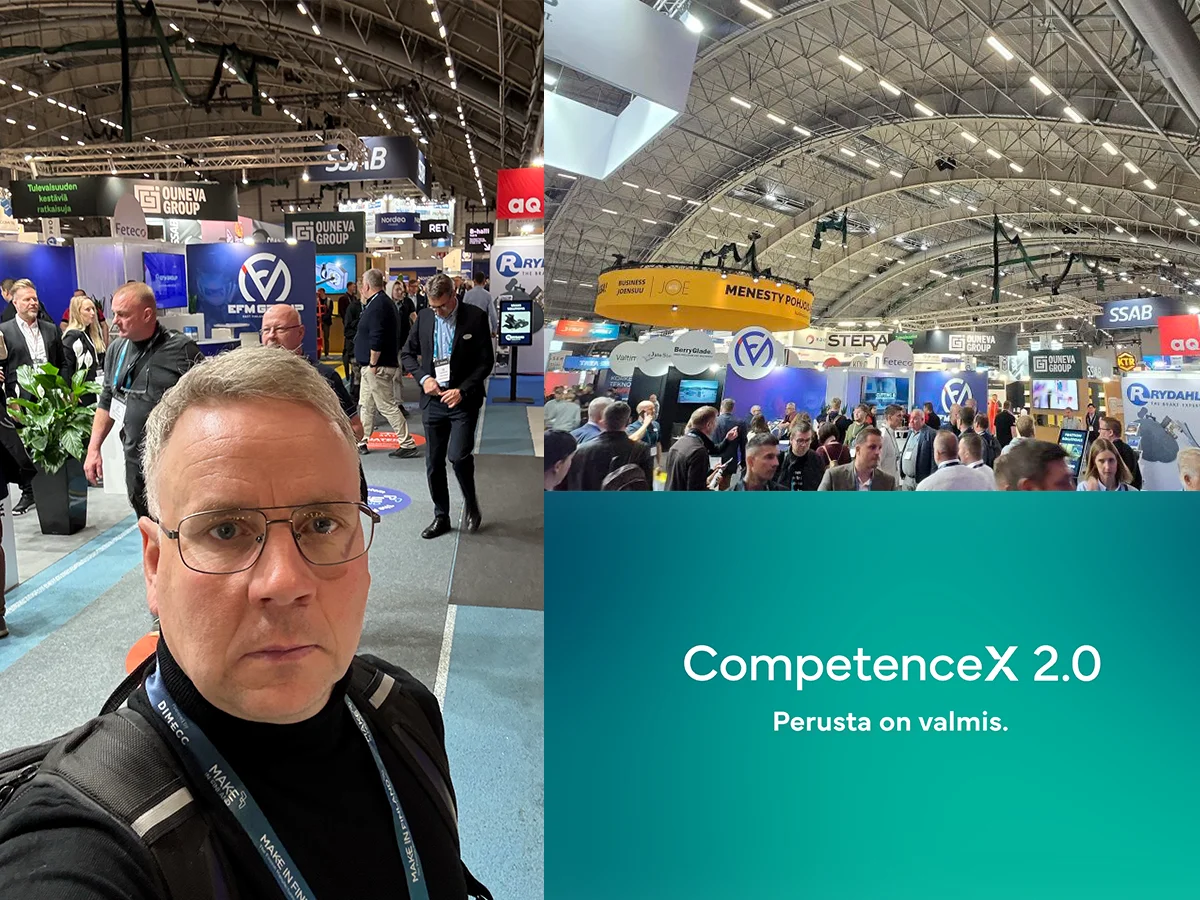
The exhibition hall was really packed! Subcontracting 2026 gathered thousands of visitors to Tampere, and the Mobie / CompetenceX team was in the middle of the hustle and bustle for two days. There was a lot of experience from Subcontracting 2026 , and here are the most important takeaways!
Santtu wore out the soles of his shoes as he toured practically the entire hall, every corner and corridor. The result was several dozen new contacts and a few particularly interesting conversations. The theme of the fair was subcontracting, and there were many sub- and component-level operators in the hall. Their parts end up in the end-users’ machines, and that is where product training is born.
Subcontracting 2026 experiences: an oil block that will never be clean
One of the strongest discussions at the fair was with a company that manufactures hydraulic blocks. The blocks are delivered to forest machine manufacturers and are used, for example, in forest machine lifts and harvester heads. The problem is practical: when a block breaks down in forest conditions, it is full of sawdust, oil and dirt, and it cannot be cleaned in the field. Cleanliness is a prerequisite for the repair to last.
The solution is the modular principle. The entire block is replaced with a finished one in the field, and the broken one is taken to the workshop for repair, in the same way that a car part is often replaced and not repaired on the side of the road. The servicer does not need to know how to dismantle the valve structures, but to replace the module correctly. That is exactly the know-how that every servicer should have in their back pocket.
At the stand of one machine manufacturer, an idea that has been written about before was also discussed: a QR code attached to the part, which is tied to the serial number and linked to up-to-date training material. The challenge lies throughout the chain, as the machine of a large machine manufacturer receives parts from up to a hundred different subcontractors.
Education is already part of everyday life: forklifts and robots
Santtu also went through all the forklift and crane companies at the fair. The common line was clear: none of them would hand over a forklift to the user without training. Ensuring competence before commissioning is a matter of course, not an additional service.
The robot manufacturing company, on the other hand, had written into its strategy that the training must be made visible and systematic, and one employee has started documenting the training content. Their robots end up in factories around the country, and they need to be both trained for use and updated continuously. Now this is done through Teams meetings and on-site visits, which is hard when there are dozens or hundreds of robots in the field.
Interviewed from industry
At the fair, Santtu also interviewed a person working in industry who develops the competence, learning culture and future capabilities of industrial cranes and the service business. The topic was how combining technology, know-how and continuous learning creates a foundation for future competitiveness.
During the fair, CompetenceX 2.0 was also announced
During the fair, Mobie announced the news of the new CompetenceX 2.0 learning environment. The platform has been built entirely in Finland by Mobie’s own coders, and its foundation is ready. Those interested can leave their contact information and be among the first to hear when the product is available.
Subcontracting 2026 experiences: what was left in hand?
Subcontracting 2026 confirmed a long-held suspicion: the need for product training is not theoretical. It is a concrete and often unresolved problem that recurs from one industry to another, from forest machines to forklifts and from robotics to hydraulics.
Next up is the Agricultural Machinery Fair in Helsinki on 8–10 October. Stay tuned, or book a 30-minute sparring session now.
Subscribe to our newsletter
Would you like to read more about product training and how to put your know-how into practice? Subscribe to our newsletter here.