
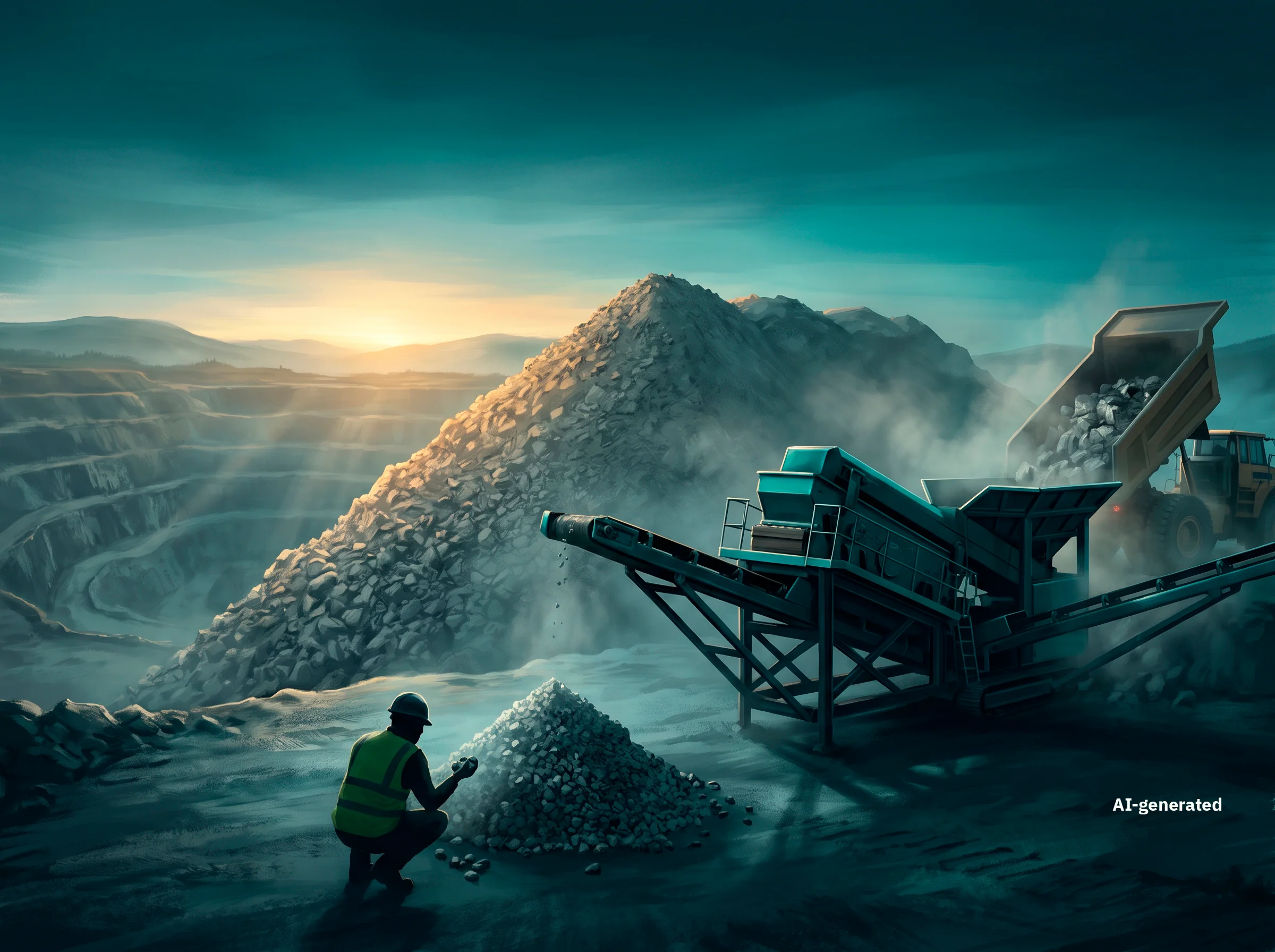
The morning sun warms the pile of waste rock that has been growing on the edge of the quarry for ten years. Now a new screening plant stands next to it, and the first load dumps rock into its feed hopper. The product starts to drip from the belt, but the grain size is not what the customer ordered. Recycling in the mining industry looks like this in everyday life: a pile, a piece of equipment and a person who needs to know what to do.
In short: In 2020, more than 100 million tonnes of mineral waste was generated in Finland, and about 7.5 per cent of it was utilised. Recycling in the mining industry means implementing a circular economy throughout the life cycle of a mine: recycling water, utilising waste rock and tailings, and recovering valuable substances. Information on utilisation already exists, but obstacles include transport costs and legislation, and the introduction of new equipment requires expertise.
Recycling in the mining sector: more than a hundred million tonnes, less than ten per cent
According to a 2023 article by GTK, the amount of mineral waste in Finland was more than 100 million tonnes in 2020, and only about 7.5 per cent of it was utilised. According to the Ministry of Economic Affairs and Employment, extractive waste and other mineral waste represent three-quarters of all waste generated in Finland each year.
Utilisation is already taking place. Waste rock is used in mine construction operations, such as roads and foundations, as well as in filling and closures. Tailings are used to raise and fill dams. In addition, waste rocks and tailings may contain valuable minerals that have not previously been exploited economically or technically. However, not all mineral waste can be utilised with current technology.
The information already exists, but the pile is not shrinking According
to GTK’s expert, the waste and side stream expertise and the necessary information already exist, but the utilisation rate is still low. There are many obstacles: in the preliminary study by the Ministry of Economic Affairs and Employment, one of the biggest challenges was seen as transport costs in relation to the commercial value of the waste, and legislation sets obstacles, especially when the material has already been classified as waste. Utilisation after disposal is challenging, so the circular economy should be taken into account as a design criterion from the very beginning.
The Ministry’s working group also points out that utilisation requires multidisciplinary expertise, research and new technological solutions.
The figures for the mining industry in this article are from GTK, the Ministry and the EU. Our field is knowledge transfer, and from that point of view, this is interesting. CompetenceX’s Santtu and Tapio heard at the Agricultural Machinery Fair that machine users return to the same question even after their own product training: how should this be done? That is why we believe that knowledge transfer is also part of the recycling discussion.
Examples can also be found in the stone industry. A Finnish natural stone company says on its website that the waste rock generated at its factory is further processed into crushed stone, which is used in road construction, among other things, and that new uses are constantly being sought for the waste rock generated at the quarry. A single example does not tell us about the situation in the entire industry, but it shows that the utilisation of waste rock is possible in practice.
Critical minerals raise the stakes
The EU’s Regulation on Critical Raw Materials sets a target for 2030 that the EU’s recycling capacity will cover at least 25% of the annual consumption of strategic raw materials. At the FinnMateria fair on Wednesday 4 November, there will be an entire seminar on the recycling and recovery of critical minerals in Hall C, with a focus on battery minerals and rare earth elements.
New methods mean new equipment and processes, and the implementation of each requires expertise.
Recycling in the mining industry and CompetenceX: putting know-how to use
In CompetenceX’s product training solution , the expert knows what they need to know and builds the training from their own source material, such as device instructions, process instructions and quality instructions. Artificial intelligence suggests the structure, tasks and images, and the expert chooses the best ones. When a material or product changes, the course is updated once, and the change is immediately available to everyone.
In the mining industry, this is already in practice: Mining Finland and Mobie have joined forces, and Mining Finland’s member companies can use the CompetenceX platform with their own agreement and turn their own technology, product and expert expertise into product training for sale.
The training can go with the product through a QR code on the side of the device, which we wrote about in the article QR code on the side of the device. The performances are visible, and the digital certificate tells who has completed the training and when. It does not replace the customer’s own process expertise or statutory training, but it puts the information in the hands of the user.
Do you want to think about how expertise is transferred to your device or process? Book a 30-minute sparring session or contact us. You can also get to know customer experiences of product training.
Frequently asked questions
What does recycling mean in the mining industry?
Recycling in the mining industry means implementing a circular economy throughout the life cycle of a mine: recycling water, utilising waste rock and tailings, and recovering valuable substances.
What can be done with extractive waste?
Waste rock is used in the construction of mines, such as roads and foundations, as well as in filling and closures. Tailings are used, for example, for raising and filling dams. Some side streams may contain valuable minerals that are sought to be recovered. Not all mineral waste can be utilised with current technology.
Why is the recovery rate of extractive waste low?
According to GTK, the expertise and knowledge already exist, but obstacles include transport costs in relation to the value of waste, legislation and the fact that utilisation after disposal is challenging. The circular economy should be taken into account as a design criterion from the start.
What is the target for recycling critical raw materials in the EU?
The EU’s Critical Raw Materials Regulation sets a target for 2030 for the Union’s recycling capacity to cover at least 25% of the annual consumption of strategic raw materials.
What is the cooperation between Mining Finland and Mobie?
Mining Finland’s member companies can use the CompetenceX platform with their own agreement and turn their technology and expert expertise into product training for sale. The goal is to combine products, technology and product training into one international entity.
How does CompetenceX help with knowledge transfer?
The expert builds the training from their own source material, and the AI suggests the structure, assignments, and images. When the material or product changes, the course is updated once. Performances are displayed, and a digital certificate tells who has completed the training.
Sources
- GTK: Why a large part of the side streams of the extractive sector remain unutilised (2023)
- Finnish stone | Loimaan Kivi
- Ministry of Economic Affairs and Employment: Working group proposes solutions for the utilisation of extractive waste (5.4.2024)
- European Commission: Critical Raw Materials Act
- FinnMateria 2026: programme
Let’s meet at FinnMateria in Jyväskylä on 4 and 5 November 2026 at the joint stand with B-101 Mining Finland or book a sparring session in advance!
Subscribe to our newsletter
Do you want to read more about product training and how to put your know-how into practice? Subscribe to our newsletter here.